Not all stump grinding is equal. It’s important to talk through the details before hiring someone to grind stumps for you.
How deep do they grind?
The first question is how deep do they grind? Many people just grind down a few inches below the surface and call it good. I feel it is important to at least grind out the root ball so that the one large organism (the tree) is now broken into a hundred smaller organisms (the roots) which die off a lot easier.
I also ask the customer if they plan to plant a tree in the same spot. If they do, I usually just grind a little deeper so they will have no problem planting a potted tree in the spot.
How far back is your stump grinder going to chase surface roots?
Second is surface roots. How far back is your stump grinder going to chase them? Personally I chase surface roots till they are less than 2" in diameter or more than 2" underground. This takes care of most of the major roots as they tend to go where the water is, and in Utah’s dry climate, where the water is, is within 2" of the surface. That is where sprinkler systems water the lawn, and most of the time it only seeps down about 2".
Whenever I’m leaving a bigger root, maybe one that does go deep underground, I poison it with stump killer so it won’t try to grow back in an inconvenient location. This is especially important to do with poplar/cottonwood trees as these will send up suckers everywhere the roots are in a last-ditch effort to save the tree. You can get a whole forest in your yard and your neighbor’s yard if you cut down a large poplar tree and don’t poison the roots/stump.
What do you do with the mulch?
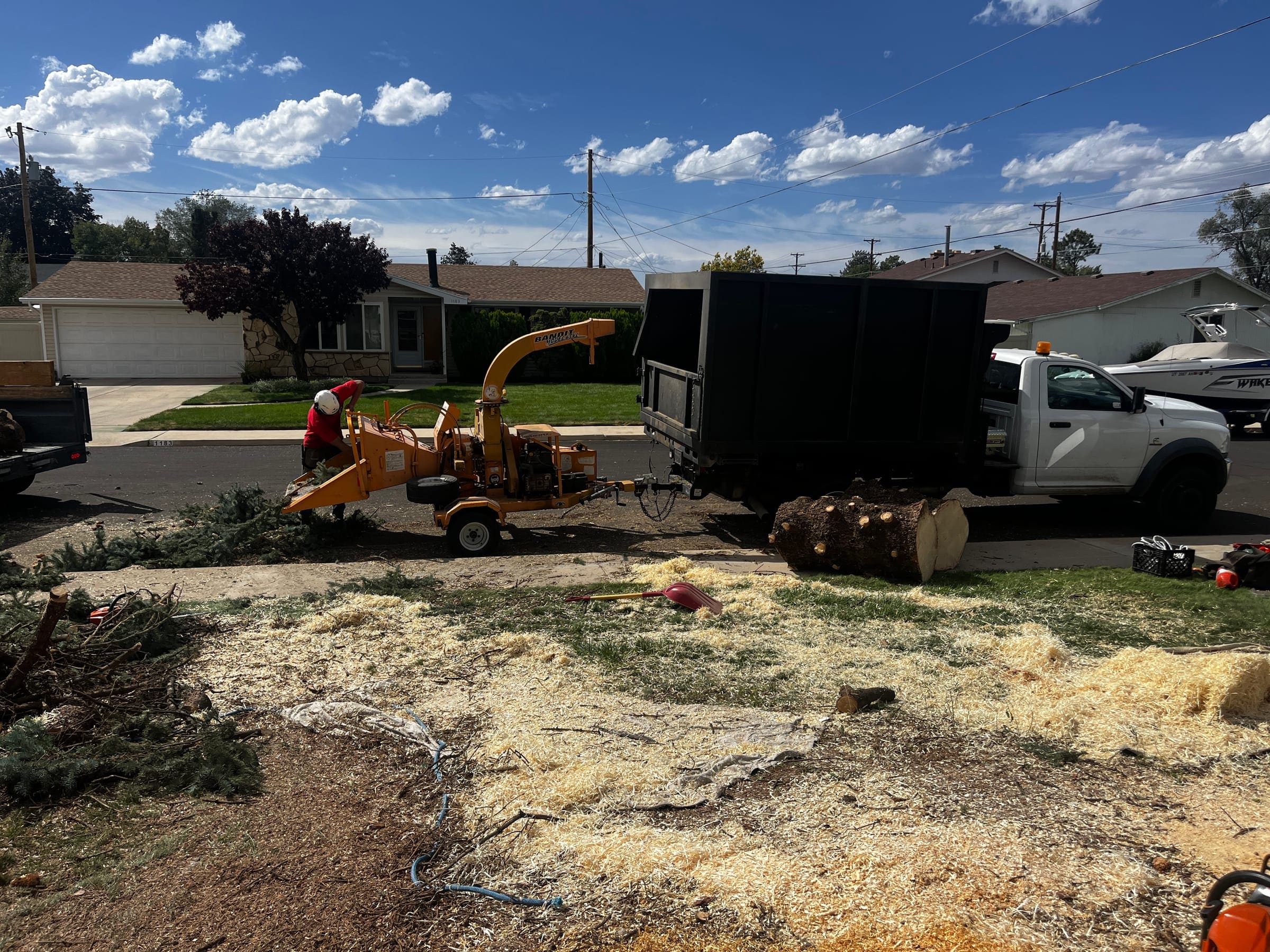
Third, what do you do with the mulch? When you grind a big stump you end up with a large amount of stump cuttings. These can be fluffy for the parts that are mostly wood from grinding the root ball, or they can be really heavy and dense dirt mixed with sawdust from chasing roots.
You want to be careful that you backfill the hole with the dense stuff, not the fluffy stuff. The dense stump cuttings can pack down just like dirt and have grass planted on top. The wood in the stump cuttings will break down over time and become rich organic matter in the soil. If you have too much of the fluffy stuff, though, this will leave voids in the fill, and the ground will sink as the wood breaks down into soil.
Grinding a 26" cottonwood stump can produce between a half and a full pickup load of stump cuttings that weigh up to 2,000 lbs. A lot of stump grinding contractors prefer “grind and go” service where they leave you to clean up all the mulch. Many offer mulch haul-away, but it costs quite a bit extra. This needs to be clear before you pull the trigger on stump grinding.
Can I plant another tree in the same spot?
Fourth, what do I do now? You had the tree removed, you had someone grind the stump and haul away the mulch, and now you have a large round patch of dirt in your yard. Many people ask, “Can I plant another tree in the same spot?” The short answer is yes, but be careful.
If you Google “Can I plant a tree in the same spot?” the general answer will be no, because the breaking down of the roots of the tree increases the acidity of the soil and will make it hard for the new tree to grow. I believe, however, if you discuss the question with the contractor ahead of time, he can grind extra deep and wide, remove the bulk of the chips and roots, and the new tree will have plenty of good ground to grow in when he is done. In addition to this, the soil of Utah is very alkaline to start with, and a little additional acidity will probably help any new tree.
Another question to ask is, am I going to end up with the same problem I had with the last tree? Did your tree die of iron chlorosis, pests, drought, weed whacker blight? Was it too big for the space, too close to the house, or otherwise unsuitable? Make sure that whatever tree you put in the same spot will not suffer the same fate.
Make sure that whatever tree you put in the same spot will not suffer the same fate.
The other option is to plant grass
The other option is to plant grass. I usually offer to either leave the ground raked flat just about 2" below grade so the homeowner can bring in sod to fill the hole, or, for an additional charge, I will bring in topsoil and grass seed, level the ground carefully, and seed the hole so that with a little water, you have a flat lawn. This is a premium service and comes with a premium price.
It is more difficult and time consuming than you might think to rake the ground flat, pack it down adequately, get it level enough that you don’t have a trip hazard, and then get the grass planted. Plus the time and expense of going to Home Depot to get dirt, get grass seed and maybe a rake… I like to think that even for a small stump we are saving you a half day or more of time and effort, plus you won’t need to store extra dirt and grass seed for the next five years. I am also not aware of a company other than Serenity Tree Care that offers reseeding after stump grinding.
How much you pay for stump grinding
At the end of the day, how much you pay for stump grinding depends on how much you are getting done, so consider carefully if going the cheap route will produce savings that will be worth the time and expense of doing it yourself.
Bryan Scoresby, owner, Serenity Tree Care
Send us the details and a photo of your stump. Get a free bid